


Python course from scratch
Want to move into IT or level up your skills for work? Start with Python — the easiest language to start with. The Python course is built on practice from scratch: 800+ tasks, each checked instantly — you see at once where the error is and how to fix it.

first level free, no cardnothing to installlearn at your own pace
Outcome
What the Python course gives you
In the course you practise the whole syntax and basics of Python and apply them to real tasks right away. Then it depends on your goal:
A start in the profession
Language basics, OOP, algorithms and data structures, Git — this is where a Python developer's path and every junior interview begin. A junior Python developer earns on average $4,950 a month.
Useful at your current job
You automate reports, Excel and PDF, collect data from websites, write bots that work in the browser on their own. Hours of manual work — in one run.
Your own projects
A scraper, a dashboard with charts, an app with a window and buttons — things you can show and actually use.
Who it's for
Who the Python course from scratch suits
The course is built for learning from scratch: no programming experience needed.
But honestly: it fits some people perfectly, and others are better off with another format.
It suits you if

You have no programming experience and want to start with the easiest language

You plan to change careers and want a solid foundation at your own pace

You work with data — analyst, marketer, finance — and want to automate routine

You study or work in IT and are adding Python as a strong skill
You already code in another language — you'll get through the first levels fast and move on to what makes Python different

You've tried to learn on your own but never got to the end — you need a clear path with practice
Since 2012, accountants, lawyers and managers have started down this path — and become developers.
Another format is better if
You're already a Python developer and write code with confidence — advanced topics and frameworks suit you better
You want live classes, a mentor and support up to your first job — see Python FullStack at JavaRush University
You're looking for ready-made code without practice — here you'll write it with your own hands (and that's a feature)
first level, no card
Maximum practice, no fluff
How the Python course works
People most often quit learning when they see no results (21.5%) or hit “the wall of difficulty” (21.1%) — that's our research. The course is built so that neither happens.
Code — from day one
A short lecture — and straight to a task. You take the first levels in the browser, in WebIDE, then move to PyCharm with our plugin — the way real developers work.
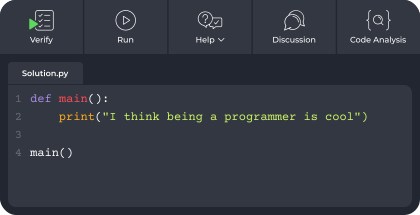
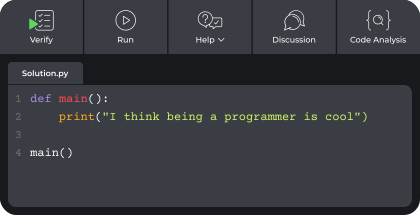
An error? The AI mentor explains
You press “Check” — and see the result a second later. Not just “error”, but what exactly is wrong and how to fix it. Any time of day.
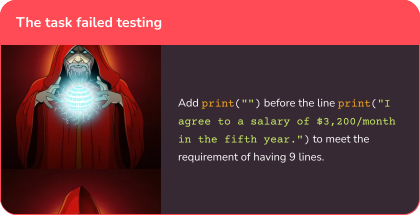
Progress you can see
64 levels, tasks, tests and achievements. Every step shows — and that keeps you going where ordinary courses lose students in week three.
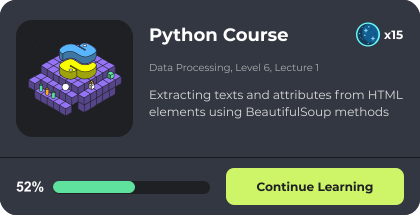
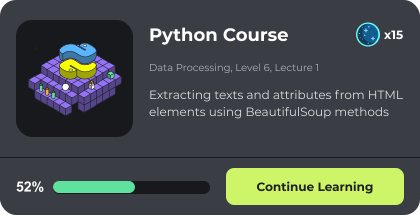
And so on — at every level with tasks
Curriculum Up to date for 2026
Python course curriculum — 6 modules
From the first line of code to automation and algorithms. Every topic is reinforced with instantly checked tasks.
- Commands and first Python program
- Introduction to types and keyboard input
- Python IDE
- Loops
- Data types in Python
- Functions in Python
- Lists
- Tuples (Tuple)
- Sets
- Strings
- Dictionaries
- Git and GitHub
- Higher-order functions
- Decorators and libraries
- Classes and objects, part 1
- Classes and objects, part 2
- Errors and exceptions
- Exceptions and debugging
- Modules and packages
- Standard errors
- Working with files and directories
- Serialization
- JSON, Introduction to networking
- Proxy, sockets and email
- Python asynchronous programming, part 1
- Python asynchronous programming, part 2
- Basics of working with Excel data using Python
- Processing and organizing data for analysis
- HTML basics for web scraping
- CSS basics for web scraping
- Basics of web scraping with BeautifulSoup
- Extracting texts and attributes using BeautifulSoup methods
- Advanced web scraping techniques
- Working with dynamic content
- Introduction to Selenium
- Working with forms in Selenium
- Selenium bot project
- Optimizing Selenium scripts
- Date and time handling for task automation
- Using the schedule library
- Data visualization with Matplotlib
- Data visualization with Plotly
- Automating PDF processing
- Working with text documents
- Image processing with Pillow
- Automating image processing
- Automating video processing with MoviePy
- Creating video effects
- Introduction to graphical user interfaces with Tkinter
- Developing GUIs for automation and data management
- Algorithms and data structures, part 1
- Algorithms and data structures, part 2
- Search algorithms and hashing, part 1
- Search algorithms and hashing, part 2
- Recursion and sorting, part 1
- Recursion and sorting, part 2
- Trees and graphs, part 1
- Trees and graphs, part 2
- Dynamic programming, part 1
- Dynamic programming, part 2
- Algorithm complexity analysis, part 1
- Algorithm complexity analysis, part 2
- IT industry and you
- Modern development
first level, no card
Practice
Tools and projects of the Python course
Over several levels in a row you build one working tool — and see tasks add up to a result.

A Selenium bot
Logs in to a site, fills in forms, goes through pages and collects data on its own — like a person, only tireless

A data scraper
Collects prices, vacancies or news from websites, cleans them up and saves them to Excel
A dashboard with charts
Turns a table of figures into clear charts and a report you're not ashamed to show
Scheduled automation
A script that collects reports, sorts files and works with Excel at the right time on its own

PDF reports and media
Pulls data out of PDFs, batch-processes images and edits video with a script
An app with a UI
A program with a window and buttons — say, a panel to run your scripts from. Works like a regular app, no browser
You'll master:
How access works
Start for free — subscribe when you want more
The first level is free, no card needed. You subscribe only if the format works for you.
First level
- 7 lectures and the first 6 tasks
- Write and check code right in the browser
- Instant checks and AI mentor hints
- Sign up in a minute
The whole Python course
- All 64 levels, 300+ lectures and 800+ tasks
- A PyCharm plugin and WebIDE in the browser
- The AI mentor and the help section
- Mini-projects inside levels
- Cancel any time, progress is kept
Want access to all programming courses — Python, SQL, Docker, Java and more?
There's the ALL IN ONE subscription.
JavaRush graduates
Join JavaRush graduates


Our graduates work at EPAM, SoftServe, GlobalLogic, Ciklum, Wix, Google, Microsoft, Amazon and hundreds of other companies. Many started from scratch — just like you.
from scratch
from 3,000+ reviews
according to JavaRush
Reviews
What Python course students say
Some finished a course for the first time, others automated their first routine at work.


 3,000+ reviews


reviews
Python in 2026
Why learn Python from scratch and how much you can earn with it
A Python developer writes the programs that run “under the hood”: the back end of sites and apps, data processing, automation and AI services. Python is No. 1 in the TIOBE index, used by 57.9% of developers, and it's the main language of AI jobs.
AI doesn't replace programmers; it raises demand for those who understand code and can give AI tools the right tasks. That's why now is a good time to start.
What you'll do
 Web services and APIs The back end of sites and apps with Django, FastAPI, Flask
 Data and reports Collecting, processing and visualizing data, dashboards and automatic reports

 Automation and bots Scripts, scrapers, Telegram bots, integrations between services
 AI and machine learning Working with models, AI assistants and services built on them
What you need to know to land your first job
Here's what a Python junior is usually asked — and where to learn it at JavaRush.
| Skill | Where to learn it |
|---|---|
| Python: syntax, collections, OOP | In this course |
| Files, networking, JSON, async | In this course |
| Algorithms and data structures | In this course |
| Git and GitHub | In this course |
| SQL and databases | SQL course — part of ALL IN ONE |
| Docker | Docker course — part of ALL IN ONE |
| Django and FastAPI web frameworks | Python FullStack at the University |
| Portfolio projects and interview prep | Python FullStack at the University |
How much Python developers earn
median, USD a month before taxCan you really learn it from scratch
Yes — and Python suits it best of all. It forgives a beginner a lot: the syntax reads almost like English, and you don't manage memory by hand. School maths and regularity are enough: one or two short lessons a day with practice get results faster than rare weekend marathons. The Python course for beginners is built exactly that way — small steps that add up to a skill.
Sources: BLS, Glassdoor · Data updated: September 2026
Sources: ITJobsWatch (UK), Glassdoor (DE, NL), StepStone · Data updated: September 2026
Sources: Just Join IT Salary Report 2026 (PL), Levels.fyi (CZ, EE) · Data updated: September 2026
Sources: Taylor.kz, Kolesa Group · Data updated: September 2026
Sources: Arc.dev Python Developer Salary 2026, Stack Overflow Survey 2025 · Data updated: September 2026
Developers with AI skills earn on average 62% more (PwC AI Jobs Barometer, 2026).
FAQ
Answers to questions about the Python course
Short and honest — about what people ask most before they start.
Yes. The course is designed for complete beginners — you don't need to know anything in advance, basic computer skills are enough. You start from the very basics and learn by doing. The first level is free — try it and see that it works for you.
No, Python is considered one of the easiest languages to start with. The syntax is close to plain English and easy to read, and you'll write your first working program on day one. The difficulty grows smoothly, step by step.
No. The course is designed for complete beginners, and you choose the pace. Accountants, lawyers and managers have moved into IT with JavaRush — many of them after 30.
It depends on your pace. People learn the basics of Python in 1–3 months, and reach a hireable level in about 6–12 months. At 5 hours a week that's about a year, at 15–20 hours — faster. You learn at your own pace, with no schedule.
Free and with no card — the first level: 7 lectures and 6 tasks. The whole course opens with a subscription — from $30 a month. There's also the ALL IN ONE subscription — for all programming courses at once.
The course gives you a foundation: the language basics, algorithms, Git and mini-projects. For a first job you'll also need SQL and frameworks. If you want to go all the way with a mentor and job search help — see Python FullStack at JavaRush University.
The Python course is self-paced learning: tasks with instant checks and the AI mentor. Python FullStack is a University program: live group classes with a mentor, frameworks and databases, code-reviewed projects and help finding a job.
No. School arithmetic is enough to program in Python — logic and problem-solving matter more than maths. Advanced maths is needed only in specific fields like data science and machine learning.
Yes. AI speeds up the work, but someone has to understand the code, check it and give AI tools the right tasks — that's what a developer does. Python is the main language of AI development, and developers with AI skills earn on average 62% more. In the course you work with the AI mentor from day one.
Automation scripts, website scrapers, Selenium bots, charts and dashboards, PDF, image and video processing, desktop apps with Tkinter.
Not to start. You take the first levels right in the browser, in the built-in WebIDE. Later you'll learn to set up PyCharm and install libraries — Selenium and others: that's part of the learning too.
The AI mentor is a smart code check: you press “Check”, and it instantly tells you what's wrong and how to fix it. It's available 24/7 — like a personal tutor who never gets tired.
Yes, any time. Your progress is tied to your account and isn't lost.
Programmers are not born
They're made — through practice. Start the Python course for free
and write your first code today.
first level free, no card