1. Call the AI agent right in the workshop
“First let’s warm up on a draft.” Alex takes the initiative. “Open not the landing page, but yesterday’s toy, the ‘Pop the Balloons’ clicker. It’s safe to make mistakes on it — then we’ll use the same gesture on the production landing page.”
Tommy opens the clicker file — it lands in the center of the IDE, in the code area. On the left is the project’s file tree, everything in plain sight.
“Now we call the agent right here. On Mac — Cmd+Esc, on Windows or Linux — Ctrl+Esc.”
A Claude Code panel opens on the side — right inside the editor, not in a separate window. Tommy squints with satisfaction:
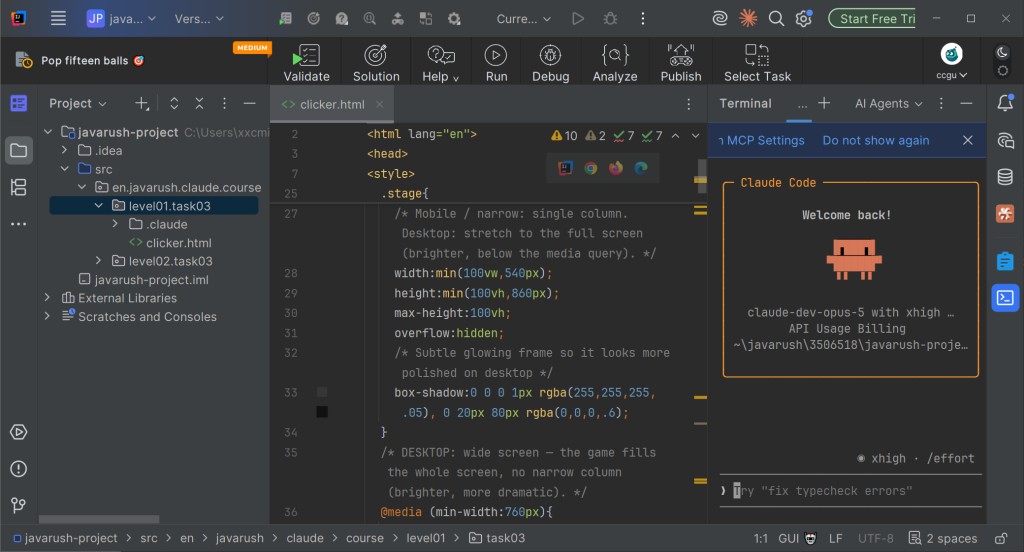
“Oh, this is the same AI agent that was in the browser yesterday? Or a new one?”
“The same one, don’t get distracted yet, we’ll figure it out in a minute,” Alex continues. “Look, it already knows which file you have open. The panel latches onto the editor by itself, nothing needs to be set up.”
“All by itself?” Tommy doesn’t believe it.
“By itself. You opened the file — it sees it. Let’s change the game title as a test.”
Tommy types the first short edit into the panel:
Sam, change the game title to "Pop the Balloons 3000".He hits Enter. A couple of seconds — and the title in the file changes: “Pop the Balloons” → “Pop the Balloons 3000”.
“All right then,” Tommy says. “It works.”
He isn’t even particularly surprised: the AI worked in the browser yesterday too. So it changed a line. So it was in the editor. Big deal.
“Good thing you weren’t surprised,” Alex notes. “That was a connection check, not a magic trick. Now the same thing, but on the production landing page, where sloppy work is no longer allowed.”
2. The edit appears in the open file — live
Tommy closes the clicker and opens TZ_LANDING.md in the editor — that very spec Alex put together in the morning. The file lands in the center, in the code area.
“Think for yourself from here,” Alex continues with a grin. “I want to see what you’ve learned.”
Tommy adopts a pompous look and writes in the chat:
Sam, we have the landing page spec in the file TZ_LANDING.md. Implement it.“I’ll do it, boss.” Sam seemed to feel all the pomp of the moment, and lines began flashing across the screen.
“10 minutes and the landing page is ready.” Tommy can’t stop being delighted. “How about that? The three of us make a fantastic team! What’s next, Alex?”
“And next, open what it made,” Alex says. “On the left, in the tree, landing/index.html has appeared. Click on it.”
Tommy clicks. The spec slides away, and the landing page code lands in the center of the screen — long, unfamiliar, but already his own.

“The same gesture as with the toy, only now for real,” Alex hints at Sam. “Ask in words. For example, change the page title.”
Tommy types into the panel, right in the editor:
Sam, change the title on the page to "The Best Offer of the Year".He hits Enter. The AI agent thinks for a couple of moments.
Tommy, out of old habit, shoots a glance to the side, at the panel: yesterday the agent reported there — “editing the file, done” — and the result had to be checked separately, over in the file tree.
And the panel is quiet.
But in the center, in that very landing page code he is already staring at, the title line flashes with highlighting — and is rewritten before his eyes. Old text, new text, exactly one line touched. Not off to the side, not in a separate window, not “here’s the result, you take it from here.” Here. In the file. In the one he has been staring at for a minute straight.
Tommy freezes with his hand on the mouse. And, without even noticing it, leans in close to the monitor.
“Wait. It… changed it right here? In my file? I’m looking right at it.”
“In the very same one,” Alex says. “See the highlighting? This was before, this is after. Accept the edit — it stays in the file.”
“But yesterday it was completely different,” Tommy says slowly, without taking his eyes off the screen. “Yesterday it wrote me ‘creating the file, done,’ and then I went separately to look at what it had cooked up in there.” He points at the highlighted line, and that slight chuckle creeps into his voice. “And now I see it literally reaching into my file with its hands. Right in front of me. This is no longer technology, Alex, this is magic.”
“There, you’ve got it.” Alex nods. “Advanced cutting-edge technology is indistinguishable from magic! By the way, the highlighting doesn’t say ‘here, done.’ It says ‘look, this is exactly what I changed.’”
Tommy gets into it and asks for more — a subheading, button text, a darker background. Every time, the edit flashes in the open file, exactly where it should, and every time he manages to catch the before/after. Yesterday’s “I talk to AI somewhere over there” melts away with every line: the tool works under his hand, in his file, and he can see everything it does.
And then a thought comes to Tommy. The light-colored page is what he decided himself, because there was nobody to ask. And what if he tries the opposite? A dark look, expensive, solid. One sentence — and there will be two options. Let them choose afterwards, and he’ll show up not with one picture, but with two.
“And most importantly,” he adds himself, “this isn’t a toy, it’s not for show. It’s a landing page. Almost the very one from Tony, with the deadline. The one that has to be shown to the client.”
“That’s the one,” Alex confirms. “What I spent half a day explaining to you, you just did with your own hands.”
Tommy leans back in his chair. The same miracle as yesterday — only now it’s not “somewhere over there,” but right at hand, in his own file.
3. Browser, editor, terminal — one agent
Tommy finally asks the question that has been hanging over him since lunch:
“Listen, is this the same AI agent or not? Yesterday there was one in the browser, now there’s a different one here. What’s the difference?”
“It’s the same AI agent. Exactly the same.” Alex seemed ready for that question. “It’s not a second Claude, not a new brain, nothing needs to be relearned. The very same one that built you Arkanoid yesterday. Only now it works on a new surface — inside the editor. The power is the same: it reads by itself, edits by itself, runs by itself. Only the PLACE has changed — where you talk to it and where you see the result.”
“So where does the browser panel go then? Do we throw it away?”
“Nowhere, nobody’s taking it away from you. And the terminal at the bottom, by the way, hasn’t gone anywhere either — see the strip? You can launch the agent from it just the same. So that’s three doors: the panel in the browser, the panel in the editor, the terminal. And the agent behind them is one and the same.”
“So it’s one agent, not two,” Tommy repeats, as if tasting it. “Different doors, one room.”
“One,” Alex agrees. “You come in from wherever is convenient.”
And now everything clicks into place for Tommy. This morning he imagined a huge new monster that had to be learned from scratch. But there is no monster — there is the same familiar AI agent, just in a new convenient package. The working landing page lives in the editor, and he saw that himself, with his own eyes.
GO TO FULL VERSION