1. Break “make it good” into tasks
At Alex’s place, Tommy comes not with murky anxiety like before, but with three clear questions. He even numbered them in his head.
“Listen, I’ve got three things,” Tommy begins. “First: how do I get the landing page to look like this.” He throws over the reference. “Make it look professional, like in the picture, not like it does now. Second: how do I make it live on the internet, not just on my laptop. And third, as a smaller thing: I want to improve my own projects too, so they look just as bright as the examples on other people’s pretty pages.”
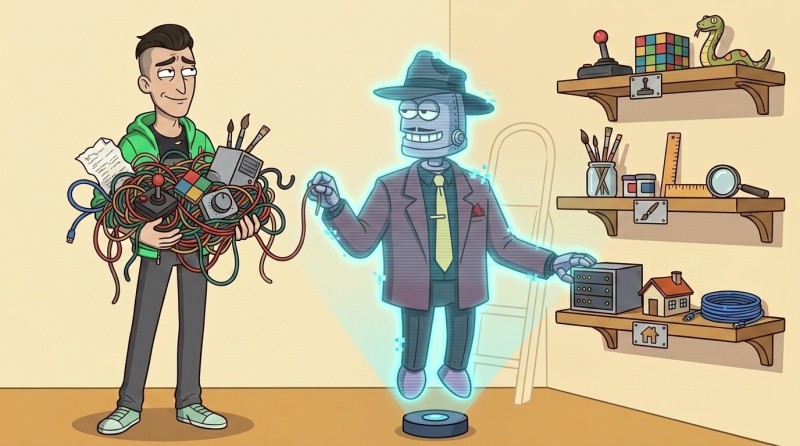
Alex doesn’t answer everything all at once in one mush. First of all, he puts the questions on different shelves — and that alone is a small lesson for Tommy.
“Look, you threw three different questions into one pile. They are about completely different things. Your second one — ‘live on the internet’ — is a question about where the site physically is. That’s a pure DevOps topic; it has nothing to do with beauty. The first one — ‘look expensive by the reference’ — is something else entirely, it’s about an arsenal of ready-made superpowers (skills) you’ll use to style the page. And the third one, about projects, is great, but it’s a bonus. We only touch it when the working delivery is actually moving. First the work, then the entertainment.”
Tommy nods. The very fact that the murky lump of “we need to make it nice and post it” has split into three separate, understandable tasks already takes away half the anxiety.
“And why can’t we do it all at once?” he tries. “Install some cool thing, and it will both deploy it and make it pretty.”
“Because those are different questions, and they use different tools.” Alex doesn’t bite. “Look. ‘Where the site lives’ is about location, about the server, about copying files. Here you can install a thousand plugins, and it still won’t look better on the outside. And ‘looks expensive’ is about an arsenal of AI skills you use to style the look. Here you can deploy it to ten servers, and the gray default landing page will still stay gray. You see? If you lump it together, they’re about different things and are solved with different tools. Don’t separate them, and you’ll keep turning the wrong knob and getting angry that it doesn’t help.”
“So I should start with the scary one, the second one,” Tommy says. “About the place. And beauty — completely separately, later.”
“Exactly. Before, you had one lump of ‘make it good’ — that’s why you didn’t know where to grab first. Then the lump broke apart — and now it’s clear what to tackle first.”
2. Why it’s important to ask the question correctly
Tommy latches onto the second question — it’s the scariest one because it’s the least clear.
“This whole ‘live on the internet’ thing — I just don’t get how. Where do I click so it gets deployed?”
And while Alex is thinking, Tommy quickly shoots another message in the chat to Tom2036: how do you deploy a site to the internet? The reply comes not as instructions, but, as always, in favorite hints.
Tommy reads it again. Same task — but the question sounds completely different. “How do I deploy it” — as if there were a magic button, and you just had to guess where to click. And “where should it live” — that’s already about a place. So the site must have some kind of home, and right now that home is his laptop, and his laptop is closed to everyone else.
And this isn’t the first time Tom2036 has fixed not the answer, but the question itself. “Again,” Tommy thinks. “I’m getting stuck not because the task is hard, but because I’m asking it wrong.” “How do I deploy it” — and the brain looks for a button that doesn’t exist. “Where should it live” — and immediately it’s clear what to look for: a place. Same bottleneck, but turn the question around — and the bottleneck disappears.
He goes back to Alex with a different mindset:
“Alex, what if we phrase it like this: my landing page needs to live somewhere so anyone can visit it. Where does it live now, and where should I put it so that everyone can open it?”
“Oh.” Alex is clearly pleased. “Now you’ve asked the right question. Feel the difference? A minute ago you were looking for a magic ‘deploy’ button, and now you’re looking for a home for your thing. This is half the battle — ask correctly. We’ll start from that, since the whole next conversation is about that. Ready for a serious lecture?”
3. Picture the agent can’t see with its eyes
“Wait.” Tommy raises a hand in front of the monitor out of habit. “Before the serious lecture, I want to go get coffee. And ask one more unresolved question.”
“I’m all ears,” Alex jokes. He seems to be in a great mood before the lecture.
“Listen, what do we do with this picture?” Tommy looks at the customer’s reference. “I can’t just tell Sam, ‘make it like this.’ How is the AI agent supposed to understand it? It works with text, with words. Can it even see the picture or not?”
Alex doesn’t expand the topic all the way — he puts the brakes on it, the way he put the brakes on the question about projects.
“Good question, and not as simple as it seems. Picture, text, ‘does it see with its eyes’ — we’ll talk about that separately when we get to the toolkit. For now, just remember that you asked the right question: you have a sample in the form of a picture, and by its nature the agent works with letters. Somewhere in between, a trick has to happen. I’ll show you what it is.”
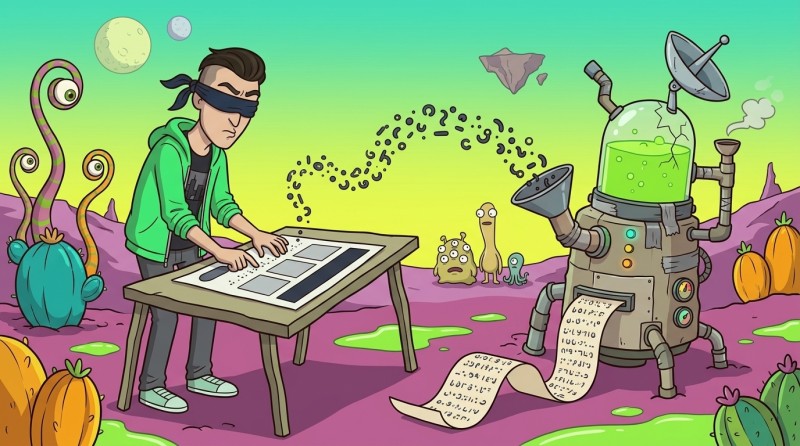
Tommy tries to figure out how this even works, and it doesn’t add up. Either the AI agent really looks at the picture like a person — but then that’s strange, because it answers in letters and has no eyes. Or it doesn’t look — but then how does it know what matters in the reference: light background, large headings, cards with shadows? He doesn’t want to describe the picture by hand, pixel by pixel, at all — that’s why he came to AI in the first place. A charming mystery; he puts it aside in the “after the main thing” pile, next to the projects.
4. Why we’re assembling the arsenal today
By the end, Alex drops a line that unexpectedly warms Tommy.
“And listen, you’re no longer a beginner in AI. Over the past week you’ve already collected more ready-made wonders than you can remember yourself. Rollbacks, skills, an agent that writes like a human. It all only makes sense today in one case.”
“In which?”
“If it helps you finish and ship this page. Not ‘oh, let’s try this cool thing too,’ not a festival of wonders for wonders’ sake. Everything that doesn’t move the landing page toward a public release today is a distraction. Remember that, it’ll come in handy later.”
Tommy winces — getting distracted by something pretty is exactly what he wants most right now. Dive into projects, throw on some shine like on other people’s screenshots, try everything new at once. And that’s exactly what Alex cuts off: not “you can’t play,” but “not now, not instead of the work.”
“So today I’m not assembling toys,” Tommy says, “I’m bringing one working thing to delivery. And the arsenal is there so I can finish faster, not so I can get stuck.”
“Now you sound like someone who works for results, not like someone who’s playing around.” Alex is clearly pleased.
“Alex, then in order.” Tommy maps out the route out loud. “First, where the site lives and how to get it out there. Then, what to use to bring it up to a high-end look. Projects and the picture — as a bonus, later. Where do we start?”
“With the word itself. What is the ‘internet,’ anyway, when you’re about to ‘deploy a site there’?”

GO TO FULL VERSION