The morning in the office starts with a short message from the client of the crypto ticker — the same guy for whom Tommy assembled a live line with bitcoin’s price yesterday and got his first real money. The message is businesslike and innocent: “hey, can you bring back that block the way it was yesterday evening? I liked it better.”
“Which ‘block’?” Tommy opens the project and gets stuck on the spot.
Yesterday he kept tweaking the ticker a dozen times: make the number bigger, change the background color, change the time format, then back again. Somewhere in the middle of the evening there was a version the client liked. But which one exactly? What phrase did he use to ask for it? What did he tell the agent so it would come out just right?
Tommy tries to scroll back through the session history — and immediately sinks. The message stream is there, but it is endless and unmarked. Dozens of “make it a little bigger,” “no, bring it back,” “now make it blue” — and not a single clue where that successful version was.
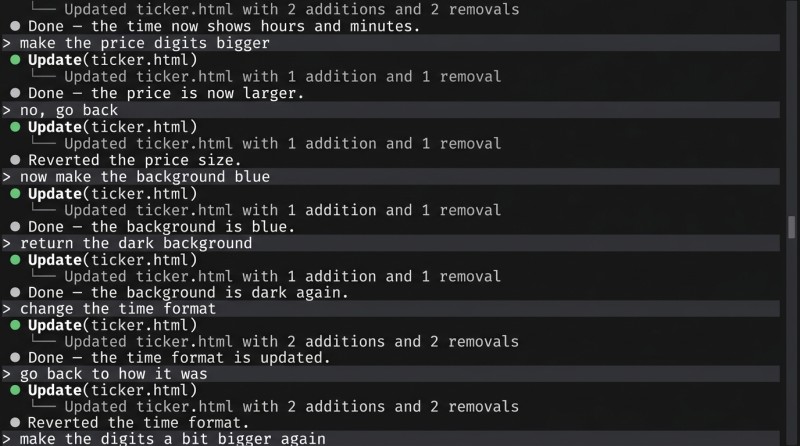
“What did we even settle on yesterday?” he mutters, scrolling the feed. Memory gives him nothing.
He comes at it from the other end — just restore yesterday’s block at random, by feel.
“Bring it back the way it was yesterday evening,” he asks the agent. He gets something close, but not quite: the client remembers a specific picture, while Tommy is now guessing. Second try, third try, adjusting by eye.
“I’m not fixing it, I’m guessing.” He snorts on the fourth try. Twenty minutes for what would have taken ten seconds if he had even one line saying “yesterday at 7:30 p.m. we settled on this.”
The irritation is stupid and painful. Not because something broke — everything works, the agent does everything you ask. But because he left no record for himself. He did a ton of stuff yesterday, found a successful option — and didn’t write down a single line.
“Nice one, Tommy from yesterday.” He snorts to himself. “Made the money, but didn’t mark where. Genius, yeah.”
And in that anger, unable to stand it, he fires off to Tom2036 — no ceremony, just like he would to his own guy when he has made a mess and is fed up: “listen, I’ve been guessing like an idiot for half an hour what we and the client settled on yesterday. My brain didn’t keep it, the history is a mountain, and it’s useless. Make it so I don’t forget anymore, okay?”
“Another riddle,” Tommy grumbles. Half of it got eaten, but he pulled out the tail: not memory, but something outside, so that you forget — and don’t lose it. “Yeah, got it, got it. I don’t need my head, I need…” He falls silent, groping for the word, and it settles by itself: notebook. A little book where everything gets written down on its own. What you asked for, when, in what words. Not in your head, but separately.
The channel, as usual, neither confirmed nor corrected it — it went quiet, as if it had not been the one steering things. But the word had already settled in Tommy, and the anger let go.
To cool off, Tommy opens the radar — and catches the same thing from the other side. The map is alive, points flash, it looks beautiful. And he looks at it and doesn’t remember what he tweaked in the build yesterday. Where did he adjust the magnitude threshold? How did he phrase it when tuning freshness? If he wants to repeat the trick on another project tomorrow, he’ll have to remember it by feel again.
“So the agent forgot,” Tommy starts, but cuts himself off. He’s not a rookie anymore. The agent forgot nothing — and it wasn’t supposed to remember. No one left a reliable trace outside. There was a conversation, there were words — and they dissolved together with yesterday, like any spoken chatter.
“It’s not about memory,” he says aloud, to nobody. “I don’t have a log.”
There it is, the exact word. A plain, boring log: what you asked for, when, in what words, where you left off. An accountant has one, a mechanic at a repair shop has one, but he, who makes cool things with real data, does not. The whole history hangs on his leaky head and blurs by morning.
The phone vibrates. In the chat with Tom2036 lies a fresh picture.
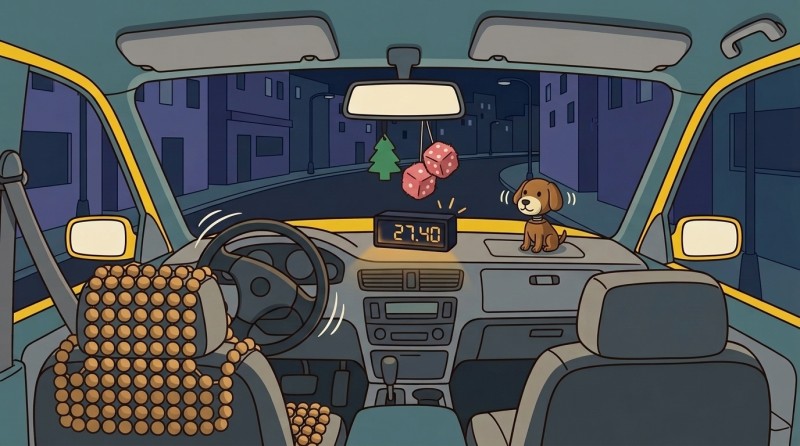
Tommy breaks into a grin.
“Oh, the machine drives itself.” He snorts. “The driver’s in clover: the wheel spins, the cash rolls in, and he’s spitting at the ceiling. That’s exactly my mood, bro.”
Technology that works while you’re busy with your own stuff — beautiful, convenient, the future has arrived. He glances at the meter ticking in the empty car and moves on — well, it ticks and it ticks, it’s a taxi after all; it’s in the black. He closes the picture without lingering.
And on that well-fed irritation, an idea clicks into place — simple and so pleasant that Tommy grins to himself.
“Why was I going to keep the log by hand anyway? I’ll ditch it by day three. Let every request fall into a file on its own. With time, with the words, just as it was. Did it — got recorded. Did it — got recorded. Won’t lift a finger.”
flowchart TB
  subgraph R["Log by hand"]
    direction LR
    R1["Day one:
wrote it down"] --> R2["Got busy —
forgot to write"] --> R3["Gave up"] --> R4["Guessing again
from memory"]
  end
  subgraph A["Recording on its own"]
    direction LR
    A1["Sent
a request"] -->|"by itself, no hands"| A2["A line in the file:
when, in what words"]
    A2 -.->|"next request"| A1
    A2 --> A3["Next day, open the file —
you see what you settled on"]
  end
  R ~~~ A
The thought immediately grows beyond the problem itself.
“If this can be done with requests — then with everything else too!” He is already pacing around the room. “Formatting. Summaries. Checks. Set it up once — after that it does everything itself.”
He is no longer thinking about the log — he is thinking about an entire invisible staff of little helpers working while he sleeps. In the evening he’s playing polished Snake or grinding 2048, and somewhere in the background his configured automations quietly comb, sort, and write all the routine work for him.
“A free crew that doesn’t whine and doesn’t smoke,” he purrs, sinking into the chair. “They work, and I just get to lie there looking good. I play games in the evening, and it’s doing something over there on its own.”
He tastes the phrase and warms to it.
Oliver, passing by, drops his old-man line:
“You get used to the system thinking for you — and you stop thinking for yourself.”
“Uncle Oliver, that’s the fun of it.” Tommy beams, not at all hurt. “I wasn’t hired to think, I was hired to live well. Let it do the thinking, and I’ll relax.”
Oliver only snorts and walks on, while Tommy doesn’t cool off from his grumbling — on the contrary, he gets even more fired up. He has no intention of slowing down now — he’s going to load up more of this “it runs itself” stuff and apply it to everything. The more “it runs itself,” the lazier and more genius he is, and that is exactly the formula he has fallen in love with today. With that enthusiasm, he heads to Alex — not to write anything down, but to automate it right away.
GO TO FULL VERSION