The best is the enemy of the good

When you retrain professionals from other fields to become programmers, you notice an interesting pattern. People who have already worked somewhere are very eager to retrain. And the longer their experience outside IT, the more diligently they study. But students sometimes, frankly, slack off.
After talking to both groups, you can find that students keep believing until the very end in “magical employment” that awaits them right after graduating from university. Next, for those who still have not taken off the rose-colored glasses ...
A guide to the real world
Each of us has needs. The need for family, friends, a home, a job, hobbies, ... But now I would like to talk about one of the most important and always relevant needs — the desire to live well and earn well.
Most people have this need. And almost everyone tries to satisfy it through work, a profession, and a career. And it seems quite logical to achieve this goal through professional development and self-fulfillment. Who among us would not want to become a top-class specialist, a professional of international level: recognition, respect, high income, great opportunities — it sounds wonderful.
So what is the action plan for all these millions and billions of future top-class workers? Quite often, the plan looks like this: finish school, prepare for university, get into university, study, graduate, find a good job, work, build an amazing career, retire.

This plan only seems correct, but it is not. The difference between a correct plan and an incorrect one is that a correct plan gets you to the goal, while an incorrect one does not.
The plan described above ignores so many real-life factors that it is hard to say what to call it: primitive, outdated, or simply wrong. What does this “most common success plan in the world” fail to account for? Competition...
Competition

1. The winner takes all
The top 5% of specialists get 50% of all the money. The top 20% of specialists get 80% of all the money.
Some companies are looking for an employee who is better, while others are looking for someone who is cheaper. The former are not afraid to overpay, but they want the very best for the money they have. The latter want to pay the smallest amount of money for the minimum quality that will satisfy them.
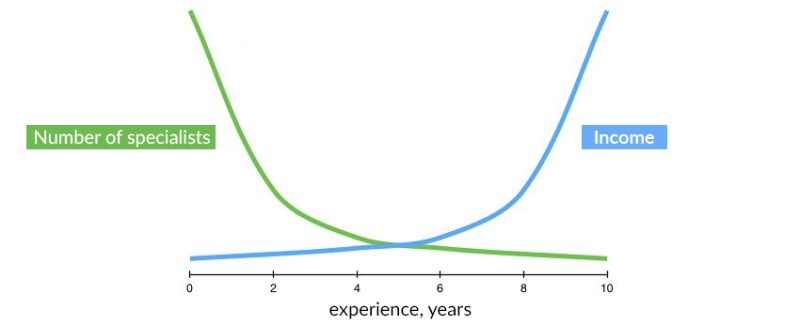
You will start your career/professional journey at the far left side of the chart. And the best place to be is on its far right side. You have a long road ahead. You need to move as quickly as possible at least into its right half. A specialist on the right side of the chart differs from a specialist on the left side by having experience — and, importantly, high-quality experience.
While you are in the left half, the number of specialists like you in the labor market is much greater than the demand for them. That means it is a buyer’s market (an employer’s market). And you have to compete with people just like you for the most lousy vacancy.
But as soon as you gain enough experience and move into the right half, the rules of the game start to change. Demand begins to exceed supply, and salaries start to rise. Five years of solid experience can turn into a tenfold salary increase. So think, look around, and learn.
But even better is to enter the top 5% of specialists. Then your fees will be limited only by how much money your clients/employers have. If someone wants to hire the best — let them pay more than everyone else. Just like at an auction.
A smart and hardworking person can enter the top 20% of specialists in 5 years. And in the next 5 years — the top 5% of the very best specialists. Here, of course, you need to do a lot of self-education and change jobs often. Sometimes you even have to work beyond normal limits.
But you do not need to work a lot (for a long time). The best specialist does not do more work — they do the work better. Better than anyone. That is why you cannot replace them with ten average workers.
If in a presidential election you got 48% of the votes and the second candidate got 47%, you did not win the support of the majority, and you did not outperform your competitor by a factor of two. You beat them by one — just one percent! But you will become president and get everything, while they will remain nobody and get nothing.
2. The loser gets nothing

If you have ever applied to a university, you may have encountered a situation where they take 200 people, but 2,000 people want to get in. Out of 1,000 applicants in a competition with 10 people per spot, only 100 will become students, and the remaining 900 will get nothing.
What do you think will happen when you graduate and start looking for a job? Competition will increase many times over!
Suppose you graduate this year from the law faculty in Berlin. Let’s say Berlin has only 10 universities, which together graduate 1,000 lawyers every year. On the market there are two vacancies with a salary of $80,000 per year, 8 vacancies with a salary of $40,000, and thirty vacancies in government organizations with a salary of $20,000.
Bummer 1: 1,000 “lawyers” and only 40 vacancies. That is, only 40 out of 1,000 lawyers will get a job in their profession, and the other 960 people, who spent 5 years studying at university, will go work as “sales managers”.
Bummer 2: You are one of the 40 best law graduates — what are your chances of getting a job? Much less than 100%, because there is also nepotism, family professions, getting hired through connections, etc. Most of those 40 vacancies will be taken by sons, nieces, and grandchildren of top managers of those same companies.
Bummer 3: You are the best graduate of your year, but you still have no real practical experience. Meanwhile, people who have already been working in the specialty for 3–5 years will also be competing for good vacancies on the market. They have accumulated experience and reputation and built connections. So you may have to start from the very bottom.
Bummer 4: You will have to work for about 3 years at “unpaid” jobs for the sake of experience, while also doing self-education, and only then will you be able to compete for good vacancies with prospects, valuable future experience, and a high salary. This is exactly the stage that should have happened at university. But if you studied at a regular university, now you will have to do all of this yourself.
3. You have nothing

All you have is a diploma, and in most cases it is not worth the paper it is printed on in the eyes of your future employer. Most often, the employer knows the “real price” of your diploma and its microscopic usefulness compared to real experience.
You have a higher education degree? Who doesn’t? There are a lot of people with higher education. It guarantees nothing. It is like a certificate that you are not an idiot, and that’s all. Universities do not provide any cutting-edge skills. Typically, in one year on a real job you will learn as much as in 4 years at university. That is life, whether you like it or not.
GO TO FULL VERSION