1. Let’s do another one
“Alex. Let’s do another one.”
“Another what, exactly?” Alex asks.
“Well, another game. A different one. You did say you can do anything, didn’t you?”
“I can,” Alex agrees without any false modesty. “Only ‘a different one’ isn’t a task. Different how?”
Tommy thinks about it. With the clicker everything was obvious: balls, click, score. And now he has to come up with what he wants himself.
“Something from childhood. Remember, there was that one — a paddle at the bottom, a wall of bricks up top, the ball bounces around, you knock it back, the bricks fly apart?”
“I remember,” Alex says. “A classic. The paddle slides left and right, the ball bounces off the walls and off the paddle, it hits a brick — the brick disappears and points drop in. You miss with the paddle — the ball flies off the bottom, game over. Right?”
“Right!”
“See,” Alex points out, “you just spent ten seconds explaining the rules of Arkanoid. That’s exactly the work nobody will do for you. Now — over to Sam.”
Tommy types:
Sam, make a browser arkanoid game in the file arkanoid.html. A paddle at the bottom,
it slides left and right following the cursor and the finger. A wall of colored bricks up top. The ball bounces
off the walls and off the paddle, it hits a brick — the brick disappears, +10 points. The ball flies off
the bottom past the paddle — game over. Score on the screen.The lines start running. Tommy no longer hunches his shoulders waiting for a wall of code — he just watches a new file show up in the file tree.
Right-click the file, Run. Paddle. Wall. The ball is off.
The first brick shatters, and Tommy catches himself leaning toward the screen. Second, third. The ball veers sideways, he drags the paddle over — made it. The score is running.
About five minutes later he snaps out of it and realizes something simple: he has made two games. In half a day. Without writing a single line of code.

2. Reworking is also a task
Tommy plays a couple more rounds and starts noticing rough edges. The bricks are all the same. Break the first one, break the twentieth — the feeling is identical. A bit dull.
“Listen,” he writes to Alex. “Can it be reworked? Or once it’s done, that’s it, too late?”
“It can,” Alex answers. “And that, by the way, is an important thing, remember it.”
“You are not required to figure everything out in advance. You don’t have to sit there for an hour composing the perfect task. You make it however it comes out — you look at it — you say what to fix. And round and round like that until you like it. This isn’t rework because you screwed something up somewhere. This is the normal way of working.”
flowchart LR
  A["Said in words
what you want"] --> B["Agent built it"]
  B --> C["Looked,
played"]
  C --> D{"Like it?"}
  D -->|"yes"| E["Done"]
  D -->|"no: boring,
clunky, not it"| F["Said exactly
what to fix"]
  F --> B
“So I can just say ‘make it better’?”
“You can. But the more precisely you say it, the fewer surprises there will be. ‘Make it better’ — and I’ll decide myself what better means. And I may well decide differently from what’s in your head.”
Tommy thinks for a second and puts it concretely:
Sam, add golden bricks to the arkanoid. Make them rare, make them look
noticeable, and have them give 30 points instead of 10.And here comes the part he wasn’t expecting. He didn’t explain all over again what the game was, where the file was, and how everything in it worked. He just said “add to the arkanoid” — and that was enough.
“Hold on,” he writes to Alex. “Does it actually remember?”
“Of course it remembers,” Alex replies. “We’re in the same session. Everything that’s been said here hasn’t gone anywhere. You’re not starting from a blank page every time, you’re continuing the conversation.”
Only 10 seconds go by and Sam reports that the job is done.
Tommy launches the game. The wall is the same — but here and there among the regular bricks, golden ones now glint. The ball clips one, and the score jumps straight up by thirty.
“Oh-ho-ho,” Tommy says out loud. “Now that’s more like it.”
Now he’s hunting. Regular bricks — those are just incidental, but a golden one has to be caught at the right moment. The game turned from “knock the ball back” into “catch the moment,” and all it took was one phrase.
3. The shelf
Tommy leans back in his chair and looks at the file tree.
This morning it was empty. Now — two files, two games. One he came up with himself, the other he pulled out of his childhood and reshaped to his own taste. And both of them can be played for real — not “well, it kind of works,” but actually played, getting hooked and swearing at every miss.
He catches that great feeling — the kind you get when you buy something you’ve wanted for ages and for a while you just keep opening it and looking at it. Except here he didn’t buy anything. He made it.
The thought sneaks up on its own: he doesn’t have to stop, does he. One more. And another. Who can even stop him?
“Tom. What are you up to?”
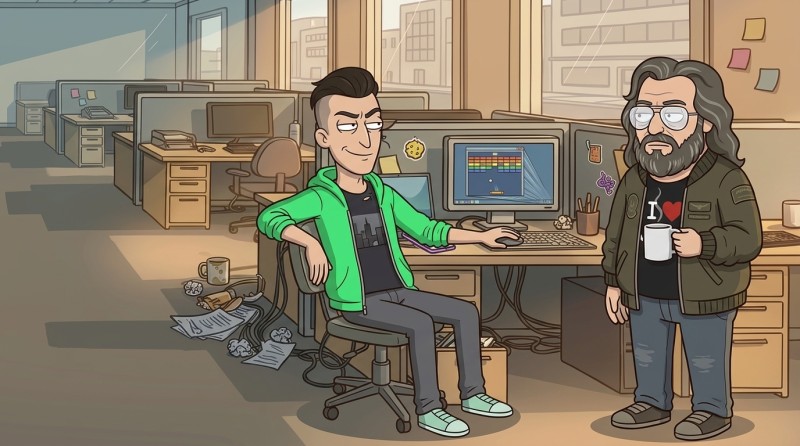
A voice behind him. Tommy quickly — faster than he should have — minimizes the arkanoid window and turns around.
Oliver. Standing there with a mug, looking at the screen over Tommy’s shoulder, and he has clearly already seen everything.
GO TO FULL VERSION