
In the morning, Tommy arrives at work already on edge. Not that he is worried — he just keeps one eye on the aisle between the desks all day. Someone walks by — Tommy snaps his eyes up for a split second: is it Oliver? He had promised himself not to spiral, to keep his emotions under control — but the promise won’t stick.
Closer to lunch, Oliver really does sit down next to him — that very same dry, slightly grouchy dev from the old school, the kind who has seen everything and is surprised by nothing. His mechanical keyboard clacks under his fingers like a typewriter, a prickly cactus sticks up on his desk, and next to it — Tommy glances sideways — stands a yellow rubber duck, the kind they put in kids’ bath tubs. Oliver pulls his chair closer so Tommy’s screen is visible and says dryly, in a by-the-book tone, as if reading out an assignment:
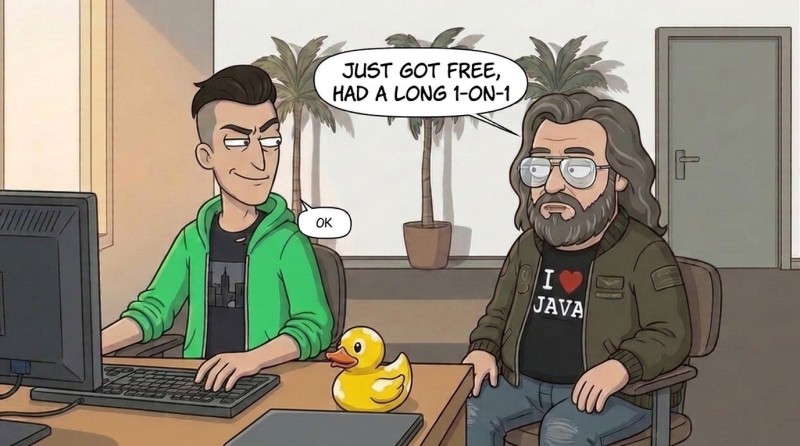
“Tom. Listen up.”
That “Tom” slightly rubs Tommy the wrong way — cold, like a doctor at the reception desk, not one bit warmer than necessary. In the office, everyone calls him Tommy, but this guy seems to be keeping distance on purpose by using his full name. But it’s not the name that catches Tommy — it’s the duck.
“Listen,” Oliver continues matter-of-factly. “Management has started an experiment with a new AI tool. It’s called Claude Code. They’re asking you to give it a try.”
Tommy listens with half an ear — his gaze still sticks to the yellow duck.

“Uncle Oliver,” he says, nodding at it with the most innocent face possible, “what’s with the duck? Missing childhood, or what? Not enough toys in the bath?”
At Tommy’s place, “Uncle Oliver” comes out with irony: out loud it sounds respectful to the older man, the master, but in reality it’s a light jab, like: hey, you’re old, Oliver, ancient. Oliver catches the “uncle” part but interprets it his own way — hears respect for his experience and narrows his eyes with barely concealed satisfaction. Both stick to their own version.
“It’s a work thing, not a toy,” Oliver grunts and pushes the duck slightly to the side, as if covering it up. “And its name is Vaska. You’ll find out what it’s for when you grow up. Don’t touch it.”
Tommy hides a grin. A grown man keeping toys in the bath — fertile ground for jokes. He has already decided to himself: at the first chance, he’ll definitely show that pedantic Uncle Oliver up — with all his cacti, ducks, and his typewriter-clacking keyboard from the 19th century. Sorry, the 20th.
And right there, something clicks inside Tommy all at once. It is Oliver. It is today. And the offer — word for word, exactly as it had come through the noise yesterday. Yesterday’s message, “tomorrow … Oliver … experiment,” was directly about the Oliver standing in front of him, and it was so precise that you can’t chalk it up to coincidence anymore.
The skepticism doesn’t disappear completely — somewhere in the background, the thought is still spinning: “well, who knows, maybe half the office is in on the experiment.” But it’s hard to believe. The one from the messenger knew more about today than some random person off the street could possibly know.
Oliver doesn’t pressure him and doesn’t insist. On the contrary, he immediately backs off:
“Actually, you can decline, keep that in mind. I’m not thrilled about this AI thing myself.” And his tone is exactly the kind old employees use when talking about yet another fashionable management gimmick. “Others have already said no; nobody gets taken to the wall for it. If it doesn’t work for you, fine.”
That only gets Tommy more fired up. If it were an ordinary day, he would have refused too — extra hassle with some incomprehensible program, who needs that? But this day isn’t ordinary. If everyone else stepped aside, and yesterday someone pointed him through the static straight at this door, then this is the door he should go through. The easier they talk him out of it, the more he wants to see what’s behind it.
He agrees so quickly that Oliver raises an eyebrow. But as soon as Oliver gets distracted by something, Tommy types into the chat with Tom2036:
Tommy reads the blacked-out lines twice. Well, I’ll be. If you added yourself to a person, then lay it all out for him already. But instead of instructions, through the black bars, only one thing comes through intact — “ask the one who’s nearby.” In other words, they’re sending him back to his colleagues at the neighboring desks.
But irritation gives way to sobriety. Whoever the stranger is, they definitely weren’t hired to live Tommy’s day for him. At most — point a finger at the door, but Tommy has to go in himself, on his own two feet. And there is logic here: no instructions from a messenger app would have taught him anything anyway. Tommy puts his phone in his pocket and turns to Oliver — since he is the “one who’s nearby.”
“Look, I’ll be honest,” he says what people usually feel awkward admitting. “I’ve never even heard of this Claude Code. What is it, anyway? Do I have to download it somewhere, install it, configure it?”
“You do.” Oliver nods and pulls a notepad closer. “Write it down, or you’ll forget half of it.”
And he starts listing.
The agent itself. A speech recognition utility, in case you want to dictate, and a separate engine for it — almost half a gigabyte. A couple of extensions for the AI agent. Next… a development environment, and three plugins for it. Then a second environment, your choice, plus two more plugins for that one. Node, Python, Java, and a build tool for it. Git, and on Windows a separate terminal on top of that.
Tommy counts down the lines with his finger and loses track somewhere in the teens.
“Uncle Oliver. How many is that in total?”
“Eighteen,” Oliver says matter-of-factly. “Plus you’ll have to log in a couple of places, set up keys. If you sit down right now and don’t get distracted — I think you’ll manage by the evening.”
“By the evening?!”
“What did you expect?” Oliver is even slightly surprised. “This isn’t installing a little app from a store. A proper developer workstation takes a day to put together, and that’s if nothing falls apart. My first time took three days — though the internet was different back then.”
He finishes his coffee, gets up, and tosses over his shoulder from the aisle:
“So get ready for a long evening. If you run into trouble — call me, I’ll tell you where to download what.”
He leaves. Tommy is left alone with a notepad holding eighteen items and with a clear understanding: today he will get nothing done. Nothing at all. The whole day will go into simply getting ready to work.
He miserably reaches for his phone — and sees that a message from Tom2036 is already sitting in the chat, sent a couple of minutes ago while Oliver was dictating his list.
There are almost no black bars in it.
Tommy reads it twice.
Then he looks at the notepad with the eighteen items. Then back at the chat.
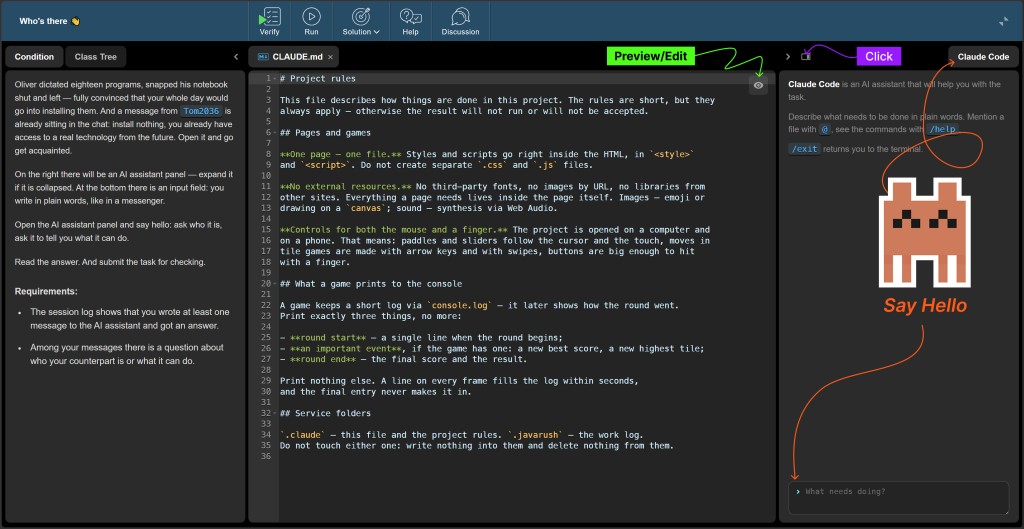

GO TO FULL VERSION